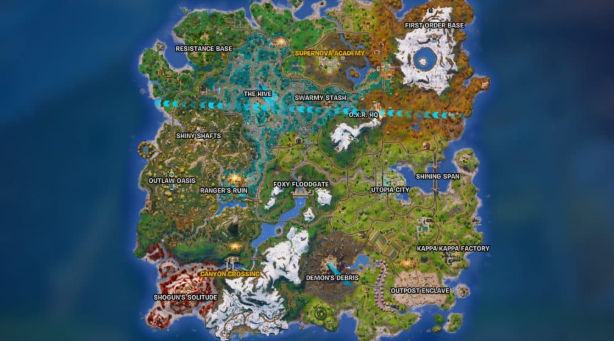
The Fortnite map is more than just terrain—it’s your battlefield, treasure trove and escape route all in one. Many players struggle to keep up with ever-shifting points of interest (POIs), terrain changes and game-meta adaptations. But what if you could walk into every match with confidence in your drop, pathing and survival strategy?
In this guide you’ll learn:
- How the Fortnite map has evolved and what the current layout looks like.
- Key POIs, hot zones and safe zones to target (or avoid).
- Practical map-based strategies to help you drop smart and survive longer.
- Answers to common questions like “Where should I land?”, “What changed this season?” and “How do I exploit map features?”.
Let’s get started and give you an edge on the island.
The Evolution of the Fortnite Map
Understanding the history helps you anticipate future changes and read the map’s signals.
Chapter by Chapter Shifts
Since launch, Fortnite has re-imagined its map multiple times:
- The original island (Chapter 1) introduced iconic POIs like Tilted Towers.
- In later chapters, new biomes, seasons and reality-bending events caused map overhauls.
- For example: In “Chapter 1 Season 5 OG” (Aug 7–Oct 2 2025) the map returned to a nostalgic version with classic and revived locations.
Why Map Changes Matter
- Loot placement and terrain impact your survival chances.
- Understanding changed POIs lets you drop in optimal zones.
- When the map updates, your usual drop-spot might become too contested or too weak.
- Staying ahead means adapting your landing, pathing and strategy accordingly.
The Current Map Layout — What You Need to Know
Let’s break down the essential geographical features of the current Fortnite map.
Major Biomes & Zones
- Deserts, jungles and snowy regions create biome-diversity that influences cover, line-of-sight and vehicle use.
- For instance, during Season 5 OG a new desert biome featured sun-drenched streets and a golf resort (Lazy Links) that changed how players approached drops.
- Rifts and dimensional cracks may appear (as seen in past seasons) altering terrain and transport.
Key Points of Interest (POIs)
Hot POIs can offer high loot but attract high competition.
- For example: Paradise Palms became a major drop in Season 5 OG thanks to its resort-style layout.
- Safe/rotational POIs: less contested areas that still give decent loot and allow you to survive the first storm ring.
- New/changed POIs: Stay informed about newly added landmarks or biome expansions by checking official patch notes.
Storm Circles & Rotation Paths
- The shrinking circle dictates the map’s pressure zones.
- Good players plan their rotation early: from your landing zone → mid-game zone → final zone.
- Knowing terrain features (hills, cover, vehicles) lets you move smarter and avoid being caught out in the open.
How to Use the Fortnite Map to Your Advantage
Here are practical, actionable strategies to leverage the map effectively.
Landing Strategy
Problem: Often newcomers pick a crowded spot and get eliminated early.
Agitation: You drop with uncertainty, land in chaos, and by minute 3 you’re gone.
Solution:
- Choose a balanced landing spot — high enough loot, but moderate traffic.
- Use the map to check proximity to the airplane path (plane-drop trajectory often lines up with central axis).
- Early game: secure a weapon and shield quickly, then assess whether to rotate or hold.
Mid-Game Movement
- Use map terrain to avoid open fields; stick to cover or edges of the storm circle.
- Use vehicles (if available) for rotation but know they give away your position.
- Be mindful of third-party positioning—look out for sound cues and high ground along your path.
Final Zone Preparation
- As the circle shrinks, terrain and POIs become critical.
- Map knowledge helps you anticipate where opponents may come from (hills, ridge lines, buildings).
- Consider dropping in elevated terrain or near strong cover for final fights.
- Use the map to plan exit/entry routes to avoid being funneled or trapped.
Map Awareness Tips
- Regularly glance at your mini-map: danger may approach opposite your screen view.
- Mark spots for future use: e.g., “east of Desert Biome there’s a vehicle spawn” or “forest at northern region has stealth loot”.
- Keep an eye on loot distribution changes that follow map updates — loot hotspots often shift after seasons.
Can I predict where the next storm circle will land on the map?
While you can’t predict precisely, you can use patterns:
- Many circles favor central or slightly off-center zones.
- Use your mini-map and terrain to pre-position early.
- Use high ground or safe buildings—map knowledge allows you to anticipate pressure zones.
How do I stay updated on map changes
- Follow official patch notes from Epic Games (developer of Fortnite).
- Visit trusted community sites like the Fortnite Wiki Map Gallery.
- Watch for in-game events: live events often trigger map shifts or new POIs.
Map Feature Deep Dive — What’s New This Season
This section highlights new or changed map features you need to know for this season.
Return of Classic Locations
With the release of OG Chapter 1 Season 5, classic locations resurfaced—giving experienced players a familiarity edge.
- Example: Paradise Palms, Lazy Links returned with updated loot and terrain.
- Knowing older layouts gives you a head-start on newer players.
Biome and Terrain Adjustments
- Desert biome expansions push players to adjust cover and rotation.
- When terrain is more open (e.g., sandy plains), early vehicle or mobility items become more valuable.
- Conversely, dense biomes (forest, jungle) demand stealth and awareness.
Loot & Bunker Locations
Some map features now include hidden bunkers or loot zones that are quiet but lucrative. For instance – an article lists all bunker locations in Chapter 5 Season 5.
- Knowing these “quiet spots” gives you an early advantage: avoid early firefights and still gear up.
- Use the map to mark or memorise these bunker zones for future use.
Internal Links (for your website)
To enhance site structure and improve user engagement, you can link to these relevant articles:
- Small Business SEO: Local Optimization Strategies
- Local SEO Services: What They Offer and How to Choose
- Website Designing & UX: Design Tips That Retain Clients
By linking here, you keep readers on your site longer and signal relevance to search engines.
External Links (for authority)
- For changelog and map gallery: visit the Fortnite Wiki Map Gallery.
- For official announcements and seasonal details: view the Epic Games blog on Season 5 OG.
Including authoritative sources bolsters your article’s credibility and supports your E-A-T (Expertise, Authoritativeness, Trustworthiness) signals.
Conclusion
The Fortnite map is your best ally when understood—and your worst enemy when ignored. By studying terrain, mastering POIs, adapting to biome changes and planning rotations, you elevate your gameplay.
What’s your experience with the Fortnite map? Which drop-zone do you favour and why? Let us know in the comments below!
And if you found this guide useful: subscribe for more tactics, gear reviews and map-based tips every Fortnite season.
FAQs
Here we answer common questions players ask about the map.
What is the best drop location on the Fortnite map
There’s no one “best” drop—depends on your play-style.
- If you’re aggressive: pick a hot POI, get loot fast, engage early.
- If you prefer survival and rotation: pick a modest POI with enough loot, fewer players.
Use the map to assess airplane path and traffic to make your choice smartly.